Top 5 Policy Management Software of 2026
As a software developer and technical architect who has spent over a decade building, scaling, and evaluating corporate enterprise systems, I have witnessed firsthand how regulatory compliance and document control have shifted. A decade ago, organizations managed operational compliance using shared cloud folders and manual spreadsheets. Today, in 2026, dynamic regulatory updates, distributed workforces, and strict audit expectations require dedicated, automated governance platforms.
Choosing the right top 5 policy management software of 2026 is no longer just about document storage; it is about mitigating corporate risk, streamlining operational workflows, and ensuring real-time attestation across your entire organization.
Whether you require policy and procedure management software for healthcare compliance, ai policy management software for automated regulatory updates, or specialized insurance policy management software, this comprehensive guide covers the premier platforms reshaping compliance technology this year.
What Is Policy Management Software and Why Is It Essential in 2026?
Policy management software is a centralized digital solution designed to create, review, approve, publish, distribute, and archive organizational policies, standard operating procedures (SOPs), and compliance documentation.
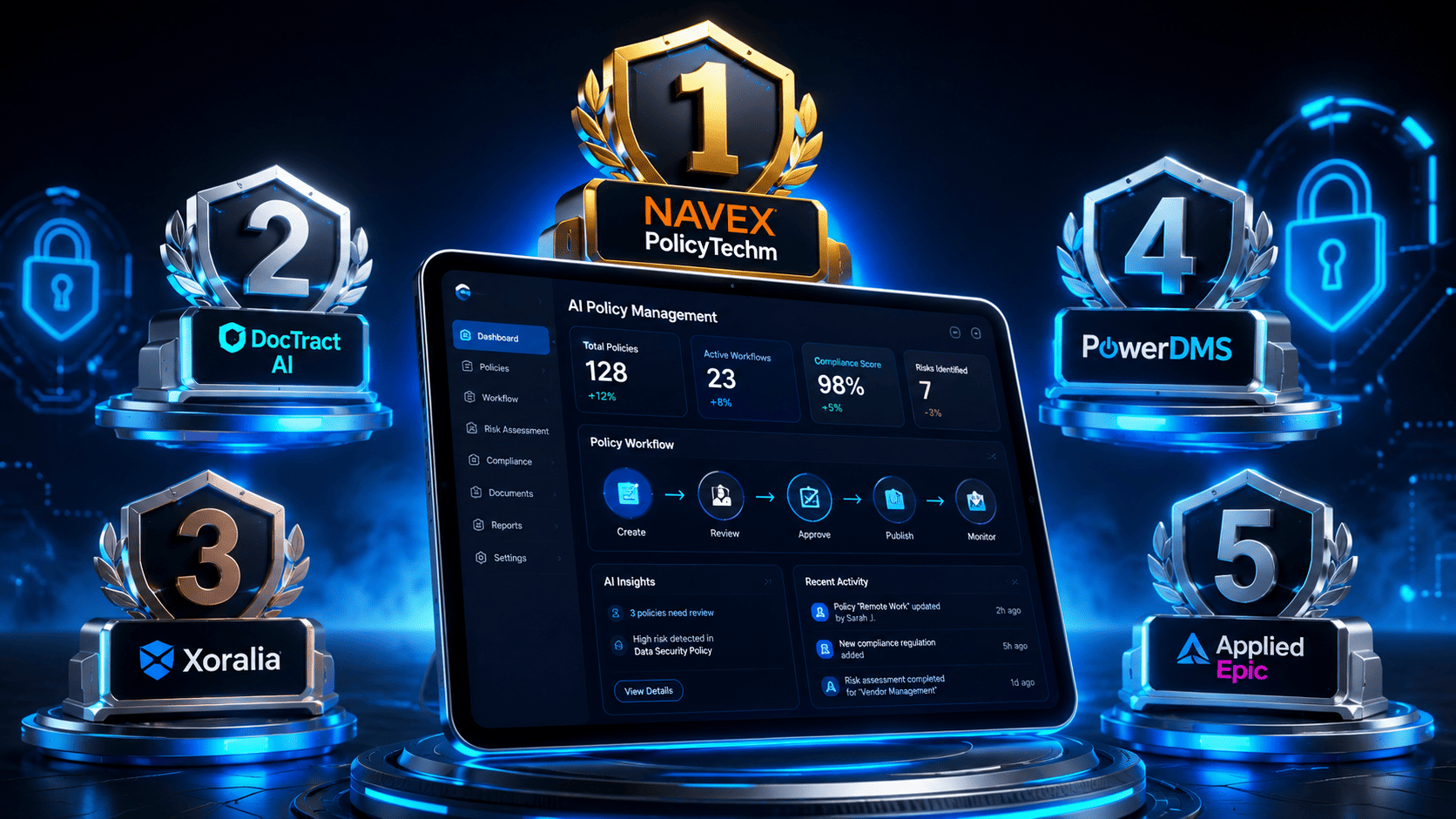
Alt Text: Top 5 policy management software of 2026 architecture showing automated compliance and policy creation workflows.
In 2026, organizations handle thousands of active documents across global jurisdictions. Relying on legacy shared drives or email chains leads to version conflicts, unacknowledged policy updates, and massive audit penalties. A purpose-built policy document management software delivers a single source of truth, establishing end-to-end version control, role-based access control (RBAC), and immutable audit trails.
Key Features to Evaluate in Modern Policy Tools
When searching for the top 5 policy management software of 2026, ensure your platform includes these critical technical capabilities:
• AI-Driven Drafting & Analysis: Modern ai policy management software uses natural language processing (NLP) to detect compliance gaps against updated laws and summarize complex policies for staff.
• Automated Attestation Tracking: Ability to send mandatory policy updates to targeted groups and collect legally binding digital signatures/read-receipts.
• Deep Active Directory & Identity Sync: Seamless integration with Entra ID (Azure AD), Okta, or group policy management software infrastructure for automated employee lifecycle management.
• Role-Based Granular Security: Enterprise encryption standards (AES-256 at rest, TLS 1.3 in transit) that comply with global data standards like ISO 27001 and Gartner's Security Benchmarks.
Top 5 Policy Management Software of 2026
Here is our in-depth evaluation of the top 5 policy management software of 2026, analyzed by operational use cases, core architecture, and compliance efficiency.
| Software Platform | Best Use Case | Core Strength |
| NAVEX PolicyTech | Enterprise GRC & Corporate | Full Lifecycle Risk Integration |
| DocTract AI | AI Document Automation | Contextual Search & Smart Drafting |
+--------------------------+-------------------------------------+-------------------------------------+
| Software Platform | Best Use Case | Core Strength |
+--------------------------+-------------------------------------+-------------------------------------+
| NAVEX PolicyTech | Enterprise GRC & Corporate | Full Lifecycle Risk Integration |
| DocTract AI | AI Document Automation | Contextual Search & Smart Drafting |
| Xoralia | Microsoft 365 / SharePoint Native | Zero SaaS Overhead for M365 Houses |
| PowerDMS | Healthcare & Public Safety | Accreditation & Standard Mapping |
| Applied Epic / WaterStreet| Insurance & Life Insurance Carriers | Policy Administration & Claims |
+--------------------------+-------------------------------------+-------------------------------------+
1. NAVEX PolicyTech (Best for Enterprise GRC & Corporate Governance)
NAVEX PolicyTech remains the gold standard among corporate policy management software solutions for medium-to-large enterprises. As a flagship module of the NAVEX One Governance, Risk, and Compliance (GRC) suite, PolicyTech connects policy lifecycle management directly with employee hotline reporting, third-party risk, and ethics training.
Key Features:
• Automated review schedules with multi-tiered escalation pathways.
• Built-in ai policy management software tools for gap analysis and language simplification.
• Deep integration with regulatory frameworks including HIPAA, GDPR, and SOC 2.
Why It Made the Top 5 List in 2026:
For enterprises managing multi-jurisdictional compliance, NAVEX provides an impenetrable audit trail that satisfies international regulatory bodies.
2. DocTract AI (Best for AI-Powered Policy Document Management)
DocTract has emerged as a disruptive leader among the top 5 policy management software of 2026 due to its deep integration of generative artificial intelligence and natural language processing.
Key Features:
• AI-Assisted Drafting & Search: Employees can ask plain-language questions (e.g., "What is our remote work travel allowance?") and receive direct, cited policy answers rather than raw PDF search results.
• Native Word & Google Docs Connectors: Policy authors edit directly inside Microsoft Word or Google Docs while DocTract handles versioning behind the scenes.
• Automated Attestation & Testing: Quizzes can be attached to policy distributions to verify employee comprehension.
Why It Made the Top 5 List in 2026:
DocTract radically reduces the time required to maintain complex policy document management software repositories through cutting-edge AI automation.
3. Xoralia (Best for Microsoft 365 & Group Policy Ecosystems)
If your organization is deeply invested in Microsoft 365, Xoralia is the premier choice. Unlike standalone SaaS tools that require separate credential management, Xoralia runs natively inside Microsoft SharePoint, Microsoft Teams, and Azure Entra ID.
Key Features:
• Zero data replication: Documents remain securely stored within your own Microsoft tenant.
• Integrates seamlessly with group policy management software and active directory structures.
• Teams integration allowing staff to read, review, and attest to policy updates without leaving Microsoft Teams.
Why It Made the Top 5 List in 2026:
Xoralia eliminates secondary SaaS licensing costs while providing enterprise-grade attestation reporting inside the environment your employees already use daily.
4. PowerDMS (Best for Healthcare, Public Safety & Accreditation)
When evaluating policy management software for healthcare and public safety sectors, PowerDMS stands out. Managing healthcare policies requires continuous alignment with changing accreditation bodies like The Joint Commission (TJC) or OSHA.
Key Features:
• Direct mapping of healthcare SOPs to external accreditation standards.
• Real-time side-by-side comparison of policy edits across historical revisions.
• Integrated testing and medical staff credential tracking.
Why It Made the Top 5 List in 2026:
PowerDMS significantly reduces the preparation time required for hospital accreditation audits, ensuring healthcare organizations maintain continuous readiness.
5. Applied Epic / WaterStreet (Best Specialized Insurance Policy Management Software)
In the commercial and financial sectors, "policy management" often refers to underwriting, policy administration, and carrier lifecycle management. Applied Epic and WaterStreet are top-tier platforms designed specifically as specialized insurance policy management software and life insurance policy management software.
Key Features:
• Complete policy lifecycle administration from quote creation and underwriting to claims handling and billing.
• Carrier integrations for real-time risk assessment and automated premium calculations.
• Multi-line policy coverage handling both P&C (Property & Casualty) and individual/group life insurance structures.
Why It Made the Top 5 List in 2026:
These platforms bridge operational policy governance with financial ledger capabilities, making them irreplaceable for insurance carriers and agency networks.
How Policy Management Software Streamlines Workflows
As a software engineer who builds operational automation tools, I always look at software through workflow efficiency metrics. Manually managing policies through email, paper forms, or unorganized network drives creates massive friction.
Here is how policy management software streamlines workflows across departments:
1. Automated Drafting & Review Routing: Instead of emailing Word documents back and forth, the platform automatically routes drafts to Legal, HR, and IT security teams sequentially or concurrently.
2. Targeted Distribution Rules: Instead of blasting every policy to all employees, rule-based engines filter policies by role, department, location, or clearance level.
3. Automated Reminders & Escalations: The platform handles follow-up notifications automatically until the employee completes the attestation.
4. Audit-Ready Reporting Dashboards: Compliance officers can generate real-time attestation completion matrices in seconds during external regulatory audits.
Developer Insights: How to Build Insurance Policy Management Software
Many engineering teams are tasked with creating custom platforms tailored to niche business rules. If your enterprise is evaluating how to build insurance policy management software or how to develop insurance policy management software, you must design your system architecture around three core layers:
+-----------------------------------------------------------------------+
| PRESENTATION LAYER |
| - Angular / React Web Portal - Mobile App (Policy Attestation) |
+-----------------------------------------------------------------------+
|
v
+-----------------------------------------------------------------------+
| BUSINESS LOGIC |
| - Workflow Engine (Camunda/Temporal) - Policy Rating & Underwriting |
| - Versioning Engine (Git-like delta) - AI Document Parsing Engine |
+-----------------------------------------------------------------------+
|
v
+-----------------------------------------------------------------------+
| DATA & SECURITY LAYER |
| - PostgreSQL / MongoDB (JSON Policy Metadata) - S3 Object Storage |
| - KMS Encryption Engine - Audit Logging DB |
+-----------------------------------------------------------------------+
Key Technical Architecture Considerations:
1. Immutable Audit Ledger: Store policy revision deltas using cryptographic hashing or append-only audit logs to guarantee non-repudiation during legal inquiries.2. Rules Engine Integration: Use business rule engines like Drools or custom microservices to handle policy rating logic, claim thresholds, and coverage eligibility.
3. API Integration Framework: Ensure native REST/GraphQL webhooks to connect seamlessly with legacy core banking platforms or modern CRM systems like Salesforce.
Final Verdict & Next Steps
Deploying one of the platforms featured in our top 5 policy management software of 2026 review is one of the highest-ROI technical investments a compliance or IT team can make.
• If your enterprise is built on Microsoft 365, evaluate Xoralia.
• If you require AI document analysis, test DocTract AI.
• If you operate in healthcare, prioritize PowerDMS.
• If you manage an insurance enterprise, adopt dedicated insurance policy management software like Applied Epic.
Investing in modern policy technology converts operational compliance from a manual chore into a streamlined, automated asset for your entire enterprise.