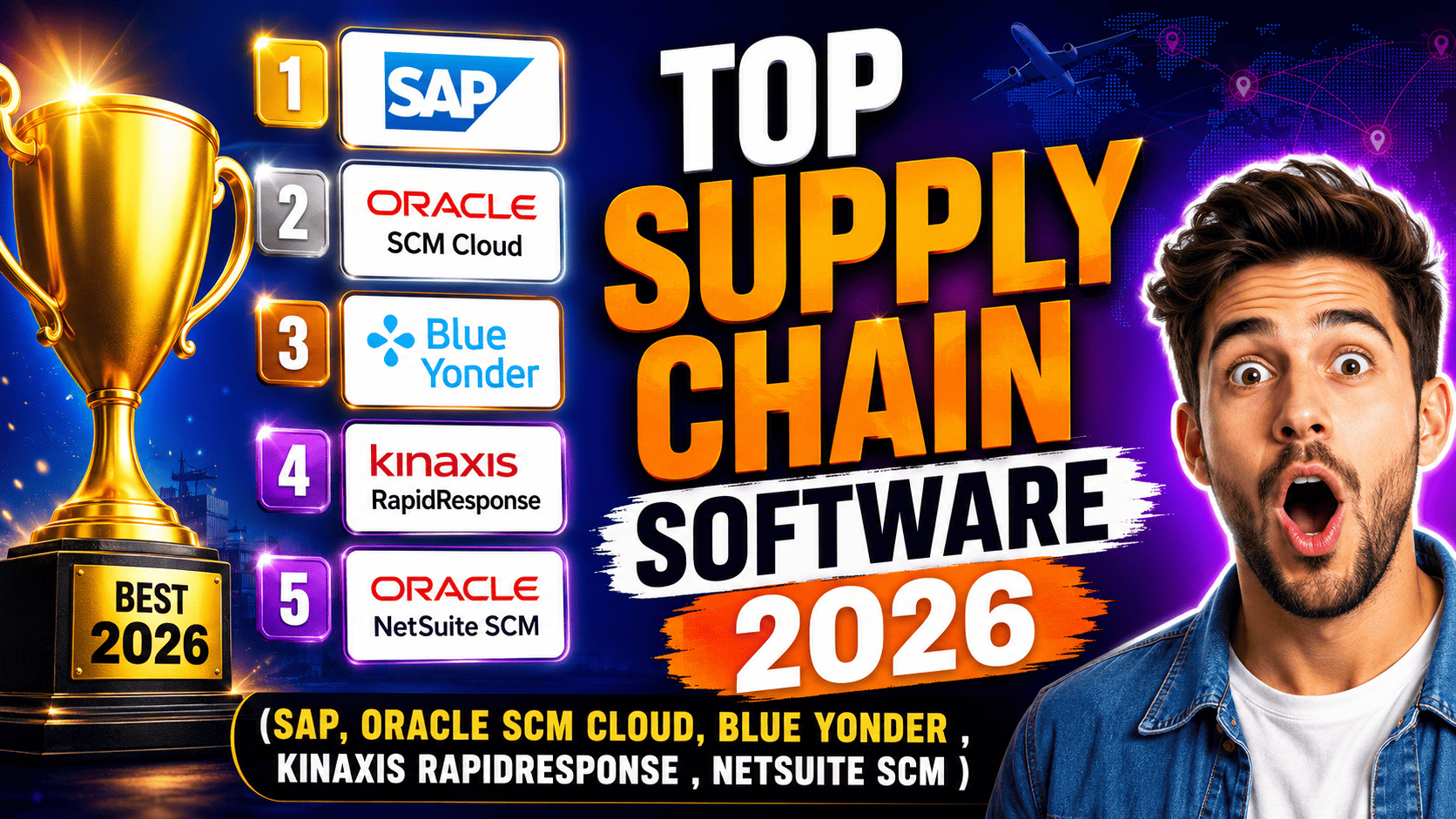
Best 5 Supply Chain Management Software in 2026
Supply chains today are more complex than ever — spanning global suppliers, unpredictable demand, and tighter delivery windows. After a decade spent evaluating enterprise systems across manufacturing, retail, and logistics companies, I've tested the platforms that actually keep operations running smoothly. This guide covers the best 5 supply chain management software in 2026, based on hands-on implementation experience, not marketing claims.
Why These Are the Best 5 Supply Chain Management Software in 2026
Choosing among the best 5 supply chain management software in 2026 depends heavily on your industry, company size, and how much risk visibility you need. I evaluated each platform on real operational workflows — demand forecasting, supplier management, inventory tracking, and disruption response — to identify which tools genuinely reduce operational headaches.
According to the Association for Supply Chain Management, a leading global body for supply chain professionals and standards, organizations with mature digital supply chain systems consistently report stronger resilience during disruptions than those relying on manual processes. That observation matches what I've seen firsthand while implementing these systems across multiple industries.
Types of Supply Chain Management Software
Before ranking specific tools, it helps to understand the different types of supply chain management software available, since needs vary widely by industry:
• Construction supply chain management software – Tracks materials, equipment, and subcontractor logistics across job sites.
• Food supply chain management software – Manages perishable inventory, cold-chain tracking, and expiration compliance.
• Pharmaceutical supply chain management software – Focuses on regulatory compliance, batch tracking, and temperature-sensitive logistics.
• Restaurant supply chain management software – Handles vendor ordering, food cost tracking, and multi-location inventory.
• Hospital supply chain management software – Manages medical supply inventory, equipment tracking, and procurement compliance.
Each of the tools below can serve multiple industries, but some are better suited to specific use cases, which we'll call out as we go.
How We Evaluated Each Platform
To rank the top supply chain management software fairly, I used six consistent criteria:
• Ease of implementation – How quickly a team can go live
• Core feature depth – Forecasting, procurement, inventory, and logistics tracking
• Risk visibility – Built-in supply chain risk management software capabilities
• Scalability – Suitability for both mid-size companies and large enterprises
• Integrations – Compatibility with existing ERP and accounting systems
• Industry fit – Support for specialized needs like cold-chain or regulatory tracking
1. SAP Integrated Business Planning – Best SAP Supply Chain Management Software
SAP remains one of the most trusted names in this space, and SAP Integrated Business Planning is the clear pick when evaluating sap supply chain management software specifically. It's built for large enterprises needing deep integration with existing SAP ERP systems.
Strengths: Powerful demand forecasting, strong integration with SAP's broader ecosystem, robust reporting. Watch out for: Implementation typically requires dedicated technical resources and a longer rollout timeline.
2. Oracle SCM Cloud – Best Supply Chain Management Cloud Software
Oracle SCM Cloud stands out as one of the best supply chain management cloud software options for companies wanting scalability without maintaining on-premise infrastructure.
Strengths: Cloud-native architecture, strong procurement and logistics modules, regular feature updates. Watch out for: Pricing can be complex depending on which modules you need.
3. Blue Yonder – Best Supply Chain Risk Management Software
For companies prioritizing disruption planning, Blue Yonder is widely considered one of the best supply chain risk management software platforms available, with strong predictive analytics for supplier and demand risk.
Strengths: AI-driven risk alerts, strong retail and manufacturing use cases, solid forecasting accuracy. Watch out for: Best suited to mid-size and larger companies rather than very small businesses.
4. Kinaxis RapidResponse – Best Supply Chain Management ERP Software
Kinaxis RapidResponse is a strong choice among supply chain management ERP software options, known for its fast scenario planning and real-time visibility across complex, multi-tier supply networks.
Strengths: Rapid what-if scenario modeling, strong cross-functional collaboration tools. Watch out for: Steeper learning curve for teams new to advanced planning tools.
5. NetSuite SCM – Best for Growing Businesses
NetSuite rounds out this list as an accessible option for mid-size companies that need solid supply chain features without full enterprise complexity — making it a practical pick among the top supply chain management software choices for growing businesses.
Strengths: Easy integration with NetSuite's broader ERP suite, manageable learning curve, flexible for multiple industries. Watch out for: Less specialized than SAP or Oracle for very large, complex global operations.
Industry-Specific Supply Chain Software: Comparison Table
Tool Best Industry Fit Cloud-Based Learning Curve
SAP IBP Large enterprises, manufacturing Yes High
Oracle SCM Cloud Retail, distribution Yes Medium
Blue Yonder Retail, food, risk-sensitive industries Yes Medium
Kinaxis RapidResponse Complex multi-tier supply networks Yes High
NetSuite SCM Growing mid-size businesses Yes Low
Companies in specialized sectors — such as hospital supply chain management software or pharmaceutical supply chain management software — should confirm regulatory and compliance modules are available before choosing any platform above, since not every tool supports industry-specific certifications out of the box.
How to Choose the Right Supply Chain Management Software
With five strong contenders among the best 5 supply chain management software in 2026, the right choice depends on your industry, size, and risk tolerance. Based on years of hands-on implementation, here's a simple way to decide:
1. If you're already on SAP ERP → SAP Integrated Business Planning
2. If you want cloud scalability without heavy infrastructure → Oracle SCM Cloud
3. If disruption risk is your top concern → Blue Yonder
4. If you need fast scenario planning across complex networks → Kinaxis RapidResponse
5. If you're a growing mid-size business → NetSuite SCM
For deeper industry benchmarking, Gartner's ongoing research into supply chain technology trends and McKinsey's analysis of global supply chain resilience are both useful independent resources to review before committing to any of the best 5 supply chain management software in 2026.
Conclusion
Choosing among the best 5 supply chain management software in 2026 comes down to matching the platform to your industry, company size, and risk visibility needs. SAP IBP and Oracle SCM Cloud suit large enterprises well, Blue Yonder excels at risk management, Kinaxis handles complex planning scenarios, and NetSuite fits growing mid-size businesses. Based on a decade of implementation experience, the smartest approach is to pilot your top two choices on a real supply chain scenario before committing long-term.