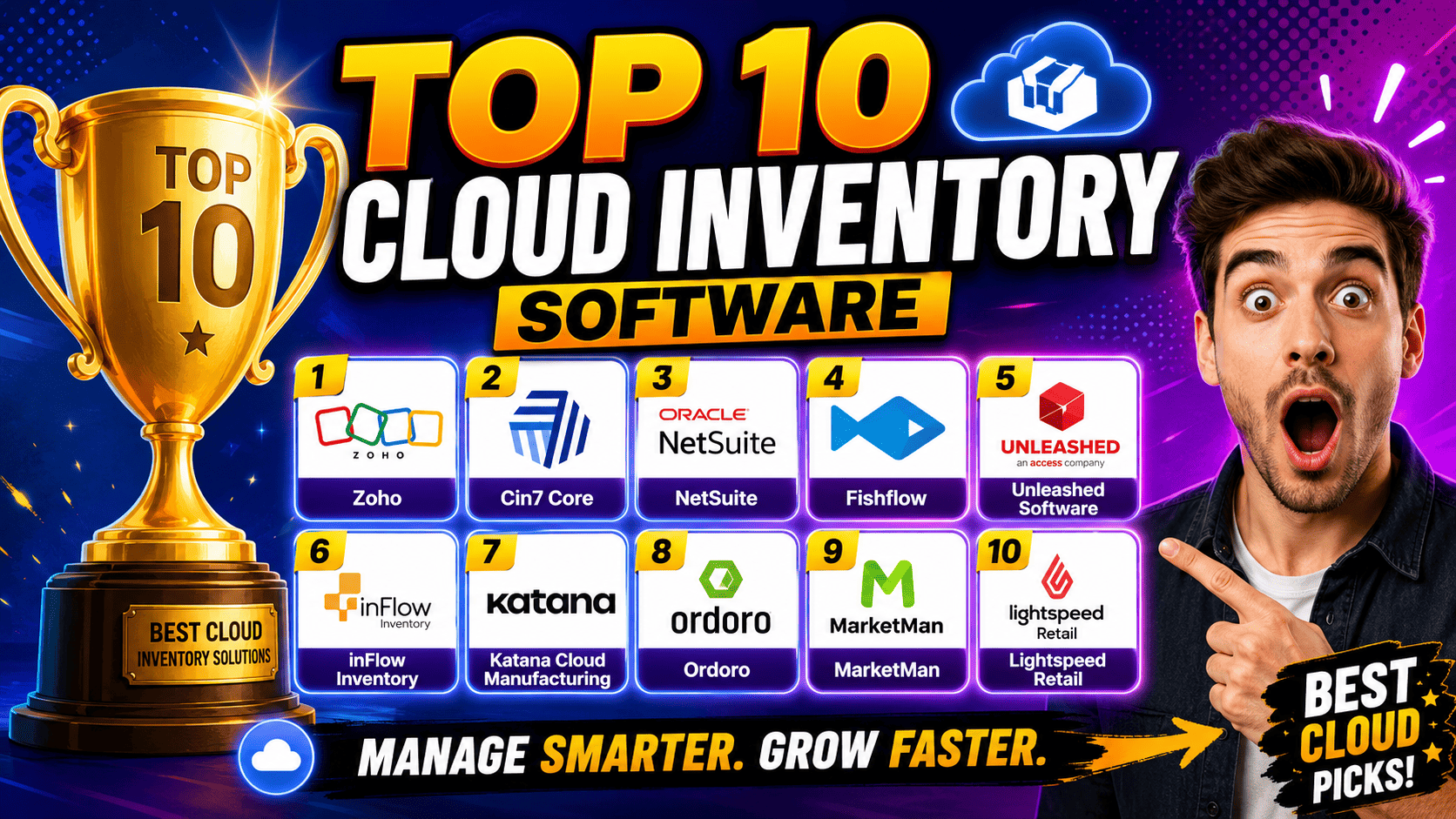
Top 10 Cloud Based Inventory Management Software 2026
Tracking inventory on spreadsheets works fine — until a business starts growing fast, and then it becomes the reason orders get missed and stock goes untracked. This guide compares the 10 cloud-based inventory management platforms worth considering in 2026, with real starting prices, what each tool is actually good (and not good) at, and how to choose between them.
Quick answer, if you're short on time:
- Best overall value: Zoho Inventory
- Best for multi-channel retail: Cin7 Core
- Best for manufacturers: Katana Cloud Manufacturing
- Best for restaurants: MarketMan
- Best for growing enterprises: NetSuite
[SCREENSHOT: dashboard view from one of your own trial signups, placed here]
Why Cloud Based Inventory Management Software Matters
Choosing the right platform from this list depends heavily on your business type - retail, restaurant, warehouse, or multi-channel e-commerce. A tool built for restaurant ingredient tracking (like MarketMan) will feel wrong for a warehouse operation, and a manufacturing-focused platform (like Katana) will have features a small retailer never touches.
Cloud-based systems have become the standard approach for inventory management because they update stock levels in real time across multiple locations without requiring a business to maintain its own servers. That shift is why almost every tool on this list is priced as a monthly subscription rather than a one-time software purchase - you're paying for infrastructure and updates, not just the software itself.
How We Evaluated Each Platform
We compared all 10 tools against six consistent criteria:
- Ease of setup - how quickly a team can get up and running without a consultant
- Core feature depth - stock tracking, reorder points, barcode scanning, reporting
- Multi-location support - real-time syncing across warehouses or stores
- Integrations - compatibility with accounting, e-commerce, and POS systems
- Pricing transparency - whether the vendor publishes real numbers or requires a sales call
- Industry fit - support for specialized needs like restaurant or warehouse operations
Top 10 Cloud Based Inventory Management Software
1. Zoho Inventory - Best Overall Value
Zoho Inventory is the most well-rounded pick on this list for businesses that want solid multi-channel selling tools without an enterprise price tag. It plugs directly into the wider Zoho ecosystem (Zoho Books, CRM, Zoho Commerce), which makes it a natural fit if you're already using any other Zoho product.
Best for: Small to mid-sized businesses selling across a few channels (Amazon, Shopify, eBay) that want an affordable, low-learning-curve tool.
Key features: Multi-channel order sync, batch and serial number tracking, built-in shipping label integration, composite item bundling.
Pricing: Free plan available (1 user, 2 locations, 50 orders/month). Paid plans start around $39/month and scale up based on order volume and features like advanced automation. (Verify current tiers on Zoho's pricing page — plan names and limits have changed more than once.)
Pros:
- Genuinely usable free tier, not just a crippled trial
- Very low learning curve for non-technical teams
- Strong value if you're already in the Zoho ecosystem
Cons:
- Advanced features (serial tracking, workflow automation) are locked behind higher tiers
- Reporting is more basic than Cin7 Core or NetSuite
- Less suited to complex manufacturing workflows
Free trial: Yes (plus a permanent free tier)

2. Cin7 Core - Best for Multi-Channel Retailers
Cin7 Core (formerly DEAR Systems) is built for retailers selling across several channels simultaneously - online store, marketplaces, and physical locations - syncing stock levels between all of them in real time.
Best for: Growing retail and wholesale businesses that are outgrowing entry-level tools and need real B2B and manufacturing support.
Key features: Multi-level bill of materials, unlimited inventory locations on every plan, 24/7 support, built-in AI product description generation.
Pricing: Standard plan starts at $349/month (5 users, 6,000 annual orders, 2 integrations). Pro is $599/month and Advanced is $999/month. Add-ons (POS, B2B portal, extra integrations) cost extra, and multiple user reviews note price increases after signup - get this in writing during your sales call.
Pros:
- Unlimited inventory locations on every tier, unlike most competitors
- Strong multi-channel and manufacturing depth in one platform
- Transparent published pricing (rare at this feature level)
Cons:
- Significantly more expensive than Zoho Inventory for comparable order volumes
- Steeper onboarding - most businesses need a proper implementation period, not a plug-and-play setup
- Annual order caps per tier can force an unplanned upgrade mid-year
Free trial: 14-day free trial
[SCREENSHOT: Cin7 Core dashboard]
3. NetSuite Inventory Management - Best for Growing Enterprises
NetSuite is Oracle's cloud ERP suite, and inventory management is one module within it. It's the right call when a business needs inventory tracking tied directly into financials, order management, and CRM - not as a standalone tool.
Best for: Companies that have outgrown standalone inventory tools and need a full ERP (finance + inventory + CRM in one system).
Key features: Real-time financial and inventory integration, advanced demand planning, multi-subsidiary support for companies operating in several countries.
Pricing: Custom quote only - NetSuite doesn't publish pricing. Implementations commonly run into the thousands of dollars per month once licensing, modules, and implementation services are included. Budget for a sales process, not a self-serve signup.
Pros:
- Deepest financial/inventory integration of anything on this list
- Scales to genuinely large, multi-entity operations
- Highly customizable for industry-specific workflows
Cons:
- No public pricing - hard to budget for without a sales call
- Steepest learning curve on this list; usually requires a dedicated implementation partner
- Overkill (and overpriced) for a small or single-location business
Free trial: Demo only, no self-serve trial

4. Fishbowl - Best for Manufacturing and Warehousing
Fishbowl is built specifically around manufacturing bills of materials and warehouse workflows, and it's known for being QuickBooks' top-ranked inventory integration.
Best for: Manufacturers and warehouse operators already using QuickBooks for accounting.
Key features: Barcode scanning, work orders and bills of materials, multi-location warehouse tracking, deep QuickBooks Desktop and Online sync.
Pricing: Starts around $329–349/month for a small team (published pricing varies by source — confirm current tiers directly with Fishbowl, as they quote per-user pricing that changes with team size).
Pros:
- Best-in-class QuickBooks integration on this list
- Strong, purpose-built manufacturing features (BOM, work orders)
- Well-reviewed onboarding/training support
Cons:
- Interface feels dated next to newer tools like Katana or Cin7 Core
- Some users report needing to reset or maintain the system more than expected
- Less intuitive for teams without inventory/warehouse experience
Free trial: Demo only

5. Unleashed Software - Best for Wholesale and Distribution
Unleashed is purpose-built for wholesale and distribution businesses that need strong batch tracking and supplier management without full ERP complexity.
Best for: Wholesalers and distributors managing supplier relationships and batch/lot tracking.
Key features: Batch and serial tracking, supplier management, real-time stock visibility across locations, strong accounting integrations (Xero, QuickBooks).
Pricing: Custom/quote-based — Unleashed doesn't publish flat pricing publicly; expect a demo call before getting a number.
Pros:
- Reviewers consistently rate it easier to set up than Fishbowl or Cin7 Core
- Strong batch/lot tracking for businesses handling perishables or regulated goods
- Solid accounting integrations out of the box
Cons:
- No published pricing makes it hard to budget-compare against competitors
- Smaller integration marketplace than Zoho or Cin7 Core
- Less suited to businesses that also need manufacturing/BOM features
Free trial: Yes
6. inFlow Inventory - Best for Small Businesses
inFlow is one of the more approachable tools on this list, built with small-business budgets and simpler workflows in mind — though "budget" is relative, since published pricing varies by source.
Best for: Small businesses that want a straightforward tool without a steep learning curve.
Key features: Barcode generation and scanning, B2B showroom for wholesale ordering, mobile apps for warehouse floor use, bill-of-materials support on manufacturing plans.
Pricing: Entry-level plans start around $149/month, though some published sources list entry pricing as low as $89–129/month and others as high as $186/month - this is a case where you should get a live quote rather than trust any single aggregator. A 14-day free trial is available with no credit card required.
Pros:
- Genuinely low learning curve - one of the easiest tools on this list to onboard a team on
- Built-in B2B showroom is a useful extra most competitors charge separately for
- No credit card required for the trial
Cons:
- Published pricing is inconsistent across sources - expect some negotiation/confirmation needed
- Fewer native e-commerce integrations than Zoho Inventory or Cin7 Core
- Add-ons (API access, extra users) add up quickly on paper
Free trial: Yes, 14 days, no credit card required
7. Katana Cloud Manufacturing - Best for Small Manufacturers
Katana combines inventory tracking with visual production scheduling, making it one of the more modern-feeling tools on this list for small manufacturers.
Best for: Small manufacturers and makers who need production planning alongside inventory tracking.
Key features: Visual drag-and-drop production scheduling, live inventory tracking tied to manufacturing orders, Shop Floor App for production teams.
Pricing: Free plan available (up to 30 SKUs - good for testing, not for running a real operation). Paid Standard plan starts at $299/month; most manufacturers who need lot traceability or advanced production routing end up closer to $700–1,000/month once add-ons are included.
Pros:
- Cleanest, most modern interface of any tool on this list
- Free plan is genuinely usable for testing before committing
- Visual production scheduling is a standout feature vs. generic inventory tools
Cons:
- Core add-ons (traceability, manufacturing routing, warehouse features) aren't included in the base price and add up fast
- Free plan's 30-SKU cap is too small for most real businesses
- Ecommerce integrations currently limited mainly to Shopify
Free trial: Free plan + 14-day trial of paid tiers
8. Ordoro - Best for E-commerce Fulfillment
Ordoro leans heavily into shipping and fulfillment alongside inventory tracking, making it a strong fit for e-commerce businesses managing orders across multiple sales channels.
Best for: E-commerce and dropshipping businesses where shipping automation matters as much as stock tracking.
Key features: Shipping label automation across carriers, dropshipping workflow support, multi-channel inventory sync.
Pricing: Starts around $59/month for the entry tier, scaling up based on order volume and features — one of the more affordable tools on this list at the low end.
Pros:
- Most affordable entry point among the multi-channel tools on this list
- Shipping/fulfillment automation is stronger than general-purpose inventory tools
- Well-suited to dropshipping-heavy operations specifically
Cons:
- Less depth on manufacturing/BOM features than Katana or Fishbowl
- Reporting is lighter than Cin7 Core or NetSuite
- Higher tiers needed quickly once order volume grows
Free trial: Yes

9. MarketMan - Best Cloud Based Restaurant Inventory Management Software
MarketMan is one of the most focused restaurant-specific inventory tools available, tracking ingredient-level stock, waste, and supplier ordering in one place - features generic inventory software simply doesn't have.
Best for: Restaurants and food-service businesses that need ingredient-level (not just SKU-level) tracking.
Key features: Recipe costing, waste tracking, automated supplier ordering, POS integrations built for hospitality.
Pricing: Custom/quote-based - pricing depends on number of locations and POS integrations required; a demo call is required to get a number.
Pros:
- Ingredient-level tracking and recipe costing that generic tools don't offer at all
- Purpose-built supplier ordering automation for food service
- Strong POS integrations for restaurant workflows specifically
Cons:
- No published pricing - harder to compare against non-restaurant tools upfront
- Not useful outside food service - a poor fit if a business has any non-restaurant inventory needs
- Requires a demo, not a self-serve signup
Free trial: Demo only

10. Lightspeed Retail - Best for Retail POS and Inventory Combined
Lightspeed combines point-of-sale and inventory tracking into one system, which appeals to retail businesses that want fewer separate tools to manage rather than bolting inventory software onto an existing POS.
Best for: Retail businesses that want POS and inventory management from a single vendor rather than integrating two separate systems.
Key features: Integrated POS + inventory, multi-location retail support, built-in reporting across sales and stock.
Pricing: Contact sales for current pricing - Lightspeed's plans are typically quoted per register/location, so get a number specific to your store count before comparing it to flat-rate tools on this list.
Pros:
- One vendor for POS and inventory removes a common integration headache
- Strong multi-location retail reporting
- Well-established in retail specifically, with mature hardware integrations
Cons:
- Less useful if you don't also need a new POS system - you're paying for a bundle you may not fully need
- Per-register pricing model makes multi-location cost harder to predict upfront
- Less manufacturing/BOM depth than Katana or Fishbowl
Free trial: Demo required

Comparison Table
|
Tool |
Best For |
Starting Price |
Free Trial |
Learning Curve |
|
Zoho Inventory |
Overall value |
Free / from $39/mo |
Yes |
Low |
|
Cin7 Core |
Multi-channel retail |
From $349/mo |
14-day |
Medium |
|
NetSuite |
Growing enterprises |
Custom quote |
Demo only |
High |
|
Fishbowl |
Manufacturing/warehousing |
From ~$329/mo |
Demo only |
Medium |
|
Unleashed |
Wholesale/distribution |
Custom quote |
Yes |
Medium |
|
inFlow Inventory |
Small businesses |
From ~$149/mo |
14-day, no card |
Low |
|
Katana |
Small manufacturers |
Free / from $299/mo |
Free plan + trial |
Low |
|
Ordoro |
E-commerce fulfillment |
From ~$59/mo |
Yes |
Low |
|
MarketMan |
Restaurants |
Custom quote |
Demo only |
Medium |
|
Lightspeed Retail |
Retail POS + inventory |
Contact sales |
Demo only |
Medium |
Prices confirmed at time of writing but change frequently — verify current pricing directly with each vendor before purchasing.
How to Choose the Right Platform
Before you shortlist based on price alone, run through these questions:
- What does your business actually do? Manufacturing (Katana, Fishbowl), restaurant/food service (MarketMan), multi-channel retail (Cin7 Core, Zoho), or pure e-commerce fulfillment (Ordoro) — the "best" tool changes completely based on this.
- How many locations/warehouses do you run? Cin7 Core includes unlimited locations on every tier; several competitors charge more as location count grows.
- What's already in your stack? If you're on QuickBooks, Fishbowl's integration is unusually deep. If you're on Zoho Books or Zoho CRM already, Zoho Inventory removes a whole integration step.
- Do you need published pricing or is a sales call fine? If procurement requires budget certainty upfront, rule out NetSuite, Unleashed, MarketMan, and Lightspeed early — none publish flat pricing.
- How fast do you need to be live? Zoho Inventory, inFlow, and Katana's free tier can be running within a day. NetSuite and Cin7 Core typically need a real implementation period.
How to Implement Cloud Based Inventory Management Software
Which tool you pick matters less than how you roll it out. Recommended process:
- Audit your current inventory data - clean up SKU lists and remove duplicates before migrating anything.
- Choose the right platform for your business type - a restaurant-specific tool like MarketMan won't fit a warehouse operation, and vice versa.
- Migrate data in stages - start with your highest-volume items rather than importing everything at once.
- Set reorder points and automation rules - this is where most of the long-term time savings actually come from.
- Train staff before full rollout - a short hands-on session dramatically improves adoption speed.
- Run parallel systems briefly - keep your old tracking method active for a short overlap period to catch discrepancies early.
For independent, vendor-neutral pricing and review comparisons, Capterra and G2 both aggregate verified user reviews worth cross-checking before committing to any tool on this list.
Conclusion
Choosing among these 10 platforms comes down to matching the tool to your business type and scale rather than picking the "best" one in the abstract. Zoho Inventory and inFlow suit small businesses well; Fishbowl and Katana fit manufacturing and warehousing; MarketMan is purpose-built for restaurants; Cin7 Core handles multi-channel retail at scale; and NetSuite makes sense once you've genuinely outgrown standalone inventory software. Trial your top two picks with real inventory data - not sample data - before committing long-term, since most onboarding pain shows up only once real order volume hits the system.
About the author: Deepak Tailor - Has implemented inventory systems for 10+ retail and e-commerce clients over 6 years of software consulting.