Custom Healthcare Software Development (2026)
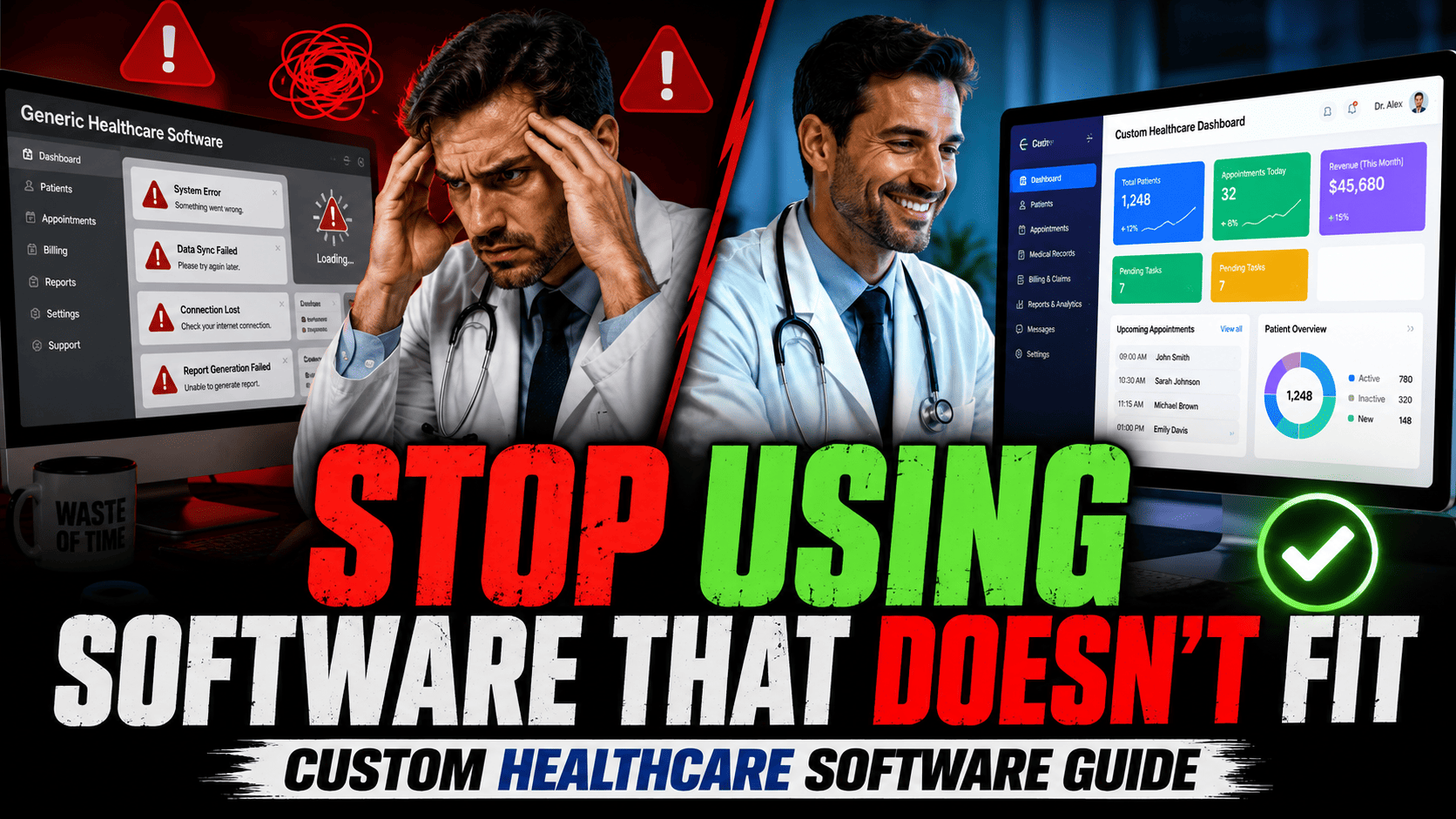
Off-the-shelf healthcare software rarely fits every clinic, hospital, or health-tech startup perfectly. Compliance requirements, patient data security, and unique clinical workflows often demand something built specifically around your operations. That's where custom healthcare software development comes in. This guide walks through what custom development actually involves, what it costs in 2026, how long it takes, and why Laravel is a strong framework choice for this kind of work.
What Is Custom Healthcare Software Development?
Custom healthcare software development is the process of designing, building, and deploying software tailored specifically to a healthcare organization's workflows, rather than adapting your operations to fit a generic off-the-shelf product. This spans everything from patient record systems for individual providers, to telehealth platforms, to enterprise systems built for large hospital networks.
Unlike pre-packaged solutions, custom builds are designed around your exact compliance needs - HIPAA in the United States, and GDPR if you handle data from patients in the EU/UK — and can evolve as your organization grows. The U.S. Department of Health and Human Services' HIPAA guidance sets out the security and privacy safeguards any software handling patient data must meet, which is exactly why purpose-built systems are often worth the investment over generic tools that were never designed around those requirements in the first place.
Why Healthcare Organizations Choose Custom Development
Generic software often forces awkward workarounds for clinical workflows, billing structures, or reporting requirements that don't match a one-size-fits-all product. The most common reasons organizations move to custom development:
- Outgrowing a rigid off-the-shelf system that can't be configured around their actual workflow
- Needing tighter compliance controls than a generic vendor's shared architecture allows
- Wanting deeper integration between clinical, billing, and patient communication tools that currently live in separate, disconnected systems
Custom vs. Off-the-Shelf: When Each Makes Sense
Custom isn't automatically the right call - it's worth being honest about the tradeoff:
Off-the-shelf makes sense when:
- Your workflows are fairly standard and don't need heavy customization
- You need to move fast and can't wait 3-6+ months for a build
- Budget is tight and a proven, already-compliant product covers your core needs
Custom development makes sense when:
- Your clinical or billing workflows don't fit any existing product without painful workarounds
- You need integrations between systems that off-the-shelf tools don't support well
- You want full control over the roadmap and data architecture long-term
- You're building a product to sell to other healthcare organizations, not just use internally
A hybrid approach - buying a core platform (like an existing EHR) and building custom integrations or a custom patient-facing layer around it - is often the most cost-effective path, and it's worth asking any development partner whether that's a better fit than a full custom build before committing to one.
Custom Healthcare Software Development Services
A capable custom healthcare software development partner should cover the full product lifecycle:
- Design and development - from UI/UX through backend architecture
- App development - patient-facing mobile apps and provider dashboards
- Core systems - EHR/EMR systems, scheduling platforms, billing tools
- AI features - predictive analytics, clinical decision support, automation
- Ongoing support and compliance updates - keeping systems current as regulations evolve
Working with a team that handles these together - rather than stitching together separate vendors for design, development, and compliance - usually means fewer integration gaps later.
Why Laravel for Custom Healthcare Software Development
Laravel is a strong framework choice for custom healthcare builds for a few concrete reasons:
- Built-in security features - protection against SQL injection, cross-site scripting, and CSRF attacks out of the box, which matters when handling protected health information (PHI)
- Robust authentication and role management - healthcare systems need granular permissions (doctors, nurses, billing staff, administrators), and Laravel's authentication ecosystem handles this cleanly
- Modular architecture - makes it straightforward to add new modules (telehealth, billing, patient portals) without rebuilding the core system
- Faster development cycles - Laravel's built-in tooling reduces repetitive coding work compared to building from scratch in a lower-level framework
- Mature ecosystem - long-term support matters for healthcare systems that need years of maintenance
Laravel handles the application layer well, but HIPAA compliance also depends on infrastructure choices - encrypted storage, audit logging, signed Business Associate Agreements (BAAs) with your hosting provider - that sit outside the framework itself. Any partner recommending Laravel should be able to speak to both.
Real 2026 Cost Ranges
Healthcare software costs vary widely because compliance, integrations, and clinical risk all add engineering work that generic apps don't need. Based on current industry benchmarks, most projects fall into three tiers:
|
Tier |
Typical Cost |
What's Included |
|
MVP / Basic |
$30,000 – $80,000 |
Core workflow (e.g., patient portal, scheduling, messaging), limited integrations, HIPAA-ready architecture |
|
Mid-complexity |
$80,000 – $250,000 |
Telehealth video, secure messaging, one or two real integrations (e.g., a single EHR via FHIR), basic analytics |
|
Enterprise / AI-enabled |
$250,000 – $500,000+ |
Multi-facility deployment, multiple EHR integrations, AI features (predictive analytics, clinical decision support), FDA-adjacent functionality where relevant |
A few things that move the number regardless of tier:
- HIPAA-specific engineering (encryption, audit logging, role-based access, BAA negotiation, penetration testing) typically adds 15–25% to base development cost
- EHR integration is one of the biggest cost drivers — connecting to an existing EHR via FHIR/HL7 is almost always cheaper than building a custom EHR from scratch, and building your own EHR is rarely the right call unless that is the product
- Team location matters: US-based development typically runs $150–250/hr, while offshore teams with genuine healthcare compliance experience run $40–90/hr for comparable work
- Ongoing costs - plan for roughly 15–25% of the initial build cost per year for maintenance, security updates, and compliance upkeep after launch
These are industry-wide benchmarks, not a quote from this agency - actual pricing depends on your specific scope. A discovery call is the fastest way to get a number tied to your actual requirements.
Custom Software Development Timeline for Healthcare Projects
A realistic timeline breaks down roughly as follows:
- Discovery and requirements gathering — 2–4 weeks
- UI/UX design and architecture planning — 3–5 weeks
- Core development (MVP) — 8–16 weeks, depending on complexity
- Compliance testing and security audits — 3–4 weeks
- Deployment and staff training — 2–3 weeks
In practice: a basic MVP typically launches in 3–4 months, a mid-complexity build with one EHR integration in 6–9 months, and a full enterprise platform with multiple integrations in 12+ months. Full enterprise systems naturally take longer, but a focused MVP built with a framework like Laravel can often reach a working, compliant product faster than starting from scratch in a lower-level stack.
Choosing the Right Custom Healthcare Software Development Company
When evaluating a partner, look beyond the portfolio and ask about:
- HIPAA compliance experience - have they built systems that passed a real third-party security audit, not just claimed compliance?
- Technology stack transparency - a team confident in their stack should explain why they'd use it for your specific case, not just list buzzwords
- Post-launch support - regulations change; your partner should offer ongoing maintenance, not a one-time handoff
- Communication process - clear milestones and regular demos reduce costly miscommunication during long builds
- BAA readiness - can they sign a Business Associate Agreement, and do they understand what it actually obligates them to?
Best Approach for Startups
Health-tech startups usually need a leaner path than large hospital systems: build a compliant MVP first, validate it with real users, then expand incrementally. This keeps initial spend closer to the $30k–$80k MVP tier rather than jumping straight to a $150k+ full build, while still meeting HIPAA requirements from day one rather than retrofitting compliance later - which is consistently more expensive than building it in from the start.
Custom AI Software Development for Healthcare
AI is increasingly part of custom healthcare builds - appointment no-show prediction, clinical documentation assistance, early risk flagging based on patient history. Building these on a well-structured backend makes it easier to integrate AI services securely without exposing PHI unnecessarily. AI features typically add a meaningful amount to project cost (often $50k–$200k+ depending on scope), so they're usually worth adding in a later phase once the core system is validated, rather than in the initial MVP.
Conclusion
Custom healthcare software development gives organizations flexibility, security, and compliance control that off-the-shelf products can't always match - but it's a real investment, typically starting around $30,000 for a focused MVP and scaling well past $250,000 for enterprise systems. Laravel is a strong framework choice for building secure, scalable, HIPAA-ready applications, though compliance ultimately depends on the full stack - infrastructure, process, and team experience - not the framework alone.
For further reading, HHS.gov's HIPAA guidance covers compliance requirements in detail, and Laravel's official documentation covers the framework's built-in security tooling.
If you're evaluating a custom healthcare software development partner for your next project, we'd welcome the opportunity to talk through your requirements and give you a real number tied to your actual scope - reach out for a free initial consultation.
About the author: Deepak Tailor - 10 years building HIPAA-compliant healthcare software, including EHR integrations and patient portal systems.